Showing posts with label ostriches. Show all posts

Monday, October 17, 2011

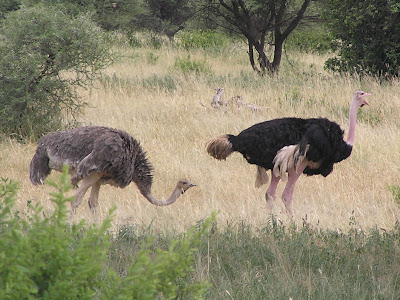
Boy, you're lookin' fine! Sexual dimorphism in birds

Ostriches (Struthio camelus) are sexually dimorphic. The male (right)
has a pinkish neck and legs, and black and white feathers. The female
(left) is mostly brown. 

When males and females of the same species have different physical forms, it is called sexual dimorphism. These differences can be in body parts, color patterns, and size.  If you are trying to identify a species, recognition that the sexes may appear different is key. I once met a woman who swore she had two species of cardinals in her yard, but after a bird walk she discovered the Northern Cardinal males are bright red whereas the females are greyish red. Same species, but different looking. 

Why?


Black-and-white casqued hornbills (Bycanistes subcylindricus).
The male on the left has a much larger casque on his bill and
less red bare skin around his eye than the female on the right. 

On the surface, it would appear that the bright colors, long tail feathers, different size, etc. are ways of attracting mates. But birds do not choose to look the way they do. These differences are produced by their genes. So why do the males and females of the same species look different?


I re-post this photo of southern red bishops (Euplectes orix) because
it shows the strong difference between the male (left) and the female
(right).

It would be easy to explain if females picked males with the sharpest claws, strongest wings, or some other characteristic that increased his chance of survival. This does happen in that only the individuals who can survive long enough to breed actually get to pass on their genes (natural selection). But color, tail length, and other “ornamentation” differences in birds are not so obvious. They have no apparent function other than attracting a mate.


A male pin-tailed whydah (Vidua macroura).

Males (and in a much smaller number of species, females) are driven to differences by the opposite sex that select them to breed with; then the genes of the male are passed on (sexual selection). So for example, if a male bird with a brighter red color than other males of its species, is chosen to breed by more females, then more of his genes are passed on to his offspring (assuming the brighter red color is a genetic).  With more genes for the brighter red color in the population, if females continue to select the brighter red males, then males continue to be the brighter red color. This is straightforward biology, but it still doesn’t answer the question of why the birds select differences in the first place.


Female pin-tailed whydahs (Vidua macroura).

We really do not know much about why birds select their mates when it comes to ornamentation. The fantastic details may help females distinguish their species from another similar one. The showy details may announce an individual’s presence so loudly that to defy getting eaten by a predator is to imply genetic superiority. It is possible that what we see as fantastic details are byproducts of some unforeseen trait; for a hypothetical example, it may be that the gene for long tails is just passed on because the birds who had them happened to have better territories or have stronger bones (but through no connection to the longer tail itself). 


A male black cuckoo-shrike (Campephaga flava) is dark and glossy with
just a small yellow gape behind the bill. 

Whatever the reasons may be, sexual dimorphism is a defining aspect in the appearance of many bird species. People sometimes ask me why the males are more beautiful, but I remind them that beauty is in the eye of the beholder. It is the female birds that do the choosing, so they have the power in the relationship (not to anthropomorphize). Inspired by slogans from the early 20th century women’s rights movements (like “equal pay for equal work”), Michele and I joke about creating a feminist-birding blog dedicated to females birds called “Equal viewing for equal birds!” Although not as showy, female birds (and non-breeding plumage males and juvenile birds) have a subtle beauty that is worth seeing too. 


A female black cuckoo-shrike (Campephaga flava) is beautiful on her
own.

For more images of sexual dimorphism in birds, see the sunbirds and weavers.

Works Consulted
  • Dawkins, R. The Greatest Show on Earth. London: Random House Group, 2009.
  • Ehrlich, P, et al. "Sexual Selection." Birds of Stanford. Accessed: October 17, 2011. http://www.stanford.edu/group/stanfordbirds/text/essays/Sexual_Selection.html
  • Fanshawe, J. and Stevenson, T. Birds of East Africa. Princeton and Oxford: Princeton University Press, 2002.
  • Owens, I. and Hartley, I. 1998. "Sexual dimorphism in birds: why are there so many different forms of dimorphism?" National Center for Biotechnology Information. Accessed October 16 2011 at: http://www.ncbi.nlm.nih.gov/pmc/articles/PMC1688905/pdf/RQQD3PMMWYMYQD4H_265_397.pdf

Tuesday, August 2, 2011

Elephants, Ostriches, and the Mighty Baobob Tree

Thundering. Towering. Too heavy to fly. Elephants. Baobob trees. Ostriches. They are giants and there are still places where these giants rule the land. Welcome to Tarangire National Park!


African bush elephants (Loxodonta africana) are the heaviest land animal on
Planet Earth and are the second tallest, only shorter than giraffes.


Tanzania borders Rwanda and stretches east to the Indian Ocean. Tanzania conserves many large wild areas, among them Serengeti National Park and Selous Game Reserve (this reserve alone is twice the size of Rwanda). Michele and I visited Tarangire National Park and were blown away by some the giants we saw.


Sunrise at Tarangire National Park

Tarangire National Park protects 2850 square kilometers of wild lands, but migratory herds of herbivores spread out over an area seven times that size during the wet season. During the dry season, many of the animals flock back to the park for food and especially water in the swamps and the Tarangire River. 


Elephants live in family groups led by a matriarch. Mature male elephants
live on their own and only join the groups for mating. In this picture, a
herd of females and young cross the Tarangire River.

Tarangire is a mix of tropical grassland, woodland, and wetland. These habitat types meet and mix and thus support a huge variety of organisms. For example, the bird list for the park contains over 550 species; that is more than all the bird species found in the states of Missouri and New York combined. We saw 145 species of birds in the two full days we were there, including birds that are only found within the region, the yellow-collared love-bird, the ashy starling, the rufous-tailed weaver, and the grey-headed silverbill.


Baobob trees (Adansonia digitata) can grow for thousands
of years. This species can be found in savannas throughout tropical
Africa and supports many species of bats, birds, insects, monkeys, and
even people (who cook the leaves and collect caterpillars for protein).


Ostriches (Struthio camelus) are the largest living bird on the planet. They
are almost entirely herbivorous (plant-eating). Males and females form mixed
flocks, but here three males shuffle their wings in unison (nice shot Michele!).


Just how big is a baobob tree? Count more than 100 cattle egrets in the
baobob on the left. Note that the left baobob is nowhere near as large as
the one to the right. Baobobs are not tall trees (maximum 25 meters), but
their giant crowns have an imposing presence on their surroundings.


Female ostriches have different colored feathers than males. Both males
and females stand about 2 meters tall, and adults weigh in between
90-130 kilograms (that' a big bird).


Elephants are strict herbivores; they eat grasses and leaves mainly but
can eat bark, fruits, and roots. Each day they can eat 100-300 kilograms of
food (I weigh about 75 kilograms), which is about 4% of their body weight.


Sunset at Tarangire... look closely for the elephant! 

Works Cited
  • “Annotated Checklist of Missouri Birds.” The Audubon Society of Missouri. Accessed 2 August 2011. http://mobirds.org/MBRC/MOChecklist.asp

  • Donegan, K. 2002. "Struthio camelus" (On-line), Animal Diversity Web. Accessed August 02, 2011 http://animaldiversity.ummz.umich.edu/site/accounts/information/Struthio_camelus.html.

  • "Checklist of the birds of New York State."  Federation of New York State Bird Clubs, Inc. Accessed 2 August 2011. http://www.npwrc.usgs.govnystate.html

  • Hankey, Andrew. “Adansonia digitata.” South African National Biodiversity Institute Website Plantzafrica.com. Accessed 2 August 2011. http://www.plantzafrica.com/plantab/adansondigit.htm

  • Norwood, L. 2002. "Loxodonta africana" (On-line), Animal Diversity Web. Accessed August 02, 2011. http://animaldiversity.ummz.umich.edu/site/accounts/information/Loxodonta_africana.html.

  • "Tarangire National Park.” Tanzania National Parks. Accessed 2 August 2011. http://www.tanzaniaparks.com/tarangire.html


Friday, May 27, 2011

Flamingos, ostriches, and other big birds of East Africa

Big birds capture the imagination, amaze the eye, and sometimes appear to defy physics. Even non-birders tend to be impressed by the big, especially brightly-colored birds. They are featured in literature (think Alice in Wonderland), in art (cranes in Asian art especially), and in urban legend/mythology (storks bringing newborns, owls having wisdom, etc.). Zoos often feature these birds not only because they can be easily seen by visitors but for conservation reasons. Big birds are easily found and hunted in the wild and are often heavily impacted by habitat alteration. Some birds, such as the lappet-faced vulture, the southern ground hornbill, and the ostrich, have suffered heavily declines due to hunting by humans. Other birds, such as the grey-crowned crane, are celebrated (national bird of Uganda) and kept as domestic pets; habitat loss and capture from the wild has subsequently decreased wild populations by up to 50%. Big birds are important contributors to their ecosystems and inspiration to many cultures; hopefully, they will remain visible in the wild in East Africa and on Planet Earth.


Although the greater flamingo is much bigger, the lesser flamingo, Phoenicopterus minor, is a  big, goofy, pink bird with a very interesting bill. We counted nearly 3000 individuals at Arusha National Park in Tanzania.


The common ostrich, Struthio camelus,  has a mass ranging from 90 to 130 kg (up to  286 lb) and stands tall at 2 meters.  Ostriches eat mostly plants and require up to 3.5 kg of food a day. They are the largest living birds on Planet Earth, although larger birds of Madagascar and New Zealand went extinct in very recent times due to hunting (in the last few hundred years). The ostrich itself has been extirpated from Southwest Asia, the Arabian peninsula, and Northern Africa. Pictured in Tarangire National Park, Tanzania.


The lappet-faced vulture, Torgos tracheliotis, is tied for the largest vulture in Africa. This species' wingspan can beat 2.8 meters; imagine its wingtips touching the ground and nearly reaching the rim of a basketball goal. While it is mainly a scavenger, this species can hunt live prey like flamingos! It has suffered heavy declines to due accidental (when it eats poisoned carcasses of carnivores) and deliberate poisoning. Pictured in Tarangire National Park, Tanzania.


Kori bustards, Ardeotis kori, are the heaviest flying birds in Africa; males can weigh up to 19 kg (over 40 lb). Although I have never heard the Kori bustard in the wild, it once captivated me at a younger age with its strange "vooomp"  boast at the Kansas City Zoo and consequently was at the top of my "have-to-see" list . Seeing them in the wild, pictured above in the Serengeti plains, is one of my favorite memories of birding in Africa so far.


The secretarybird, Sagittarius serpentarius, is a unique bird of prey that stalks arthropods, small mammals, and reptiles by looking for movement and then striking or chasing after them. While its wingspan ranges from 1.2 to 1.35 meters, giving it much longer wings than martial eagles and Kori bustards, it is only about half the wingspan of the lappet-faced vulture. Picture in Serengeti National Park, Tanzania.


Depending on age, genetics, and other factors, the martial eagle, Polemaetus bellicosus, competes with African crowned eagles and Verreaux's Eagles for the title of Africa's largest eagle. Although it generally sticks to smaller prey like hares, wild cats, hyraxes, and chicken-sized birds, martial eagles can and do successfully hunt monkeys, baboons, and even small antelope. Picture from Tarangire National Park, Tanzania.


The goliath heron, Ardea goliath, is the largest of all living herons.  Its wingspan on average is 2 meters, and it prefers to eat big fish (fish measuring, on average, 30 centimeters, longer than my forearm). Although the patterns cannot be seen in this picture, note its thick bill. For a while, blacksmith and crowned lapwings roamed next to the bird, underscoring how large this individual was. Seen in Serengeti National Park, Tanzania.


The southern ground hornbill is one of two species of ground hornbill, both found in Africa. Bucorvus leadbeateri is very large, and although it does fly, it spends most of its time walking around snatching arthropods and reptiles from the ground. We have seen only two, both at Lake Manyara. This bird is a female, determined by the presence of blue on the neck under the bill (not visible in the picture).


Verreaux's Eagle-Owl is small compared to the other birds on this post, but it is sub-Saharan Africa's largest owl; only two other owls get close. This species, Bubo lacteus, was seen awake at Tarangire National Park in Tanzania just before sunset. 


This page does a poor job of showing the storks of East Africa. I have seen black storks, white storks, yellow-billed storks, and African open-billed storks, all of which are big birds. Marabou storks, however, can get to be the largest of them all. The marabou stork, Leptoptilos crumeniferus, is also probably the least attractive of the storks, though beauty is in the eye of the beholder. Picture at Akagera National Park, Rwanda.


Grey crowned cranes, Balearica regulorum, can be found in East and Southern Africa. These individuals were seen in Lake Manyara National Park, in Tanzania, but I have seen them several times in Rwanda as well. Despite having wingspans up to 2 meters and standing around a meter high, they only weigh 3 to 4 kilograms (about 7-8 lb). 

Other birds that belong on this page that I have seen but do not have pictures are the great white pelican and the pink-backed pelican. Birds that belong here that I have not yet seen are the saddle-billed stork, Denham's bustard, and the shoebill. Also, I could include a number of herons, perhaps the sacred ibis, the white-backed vulture, and Rueppell's griffon vulture. Another day...

Works Cited

  • Anderson, M. 2008. Lappet-faced vulture” (On-line), ARKive: Images of Life on Earth. Accessed May 26, 2011. http://www.arkive.org/lappet-faced-vulture/torgos-tracheliotos/#text=Biology
  • Bible, J. and T. Root. 2007. "Ardeotis kori" (On-line), Animal Diversity Web. Accessed May 26, 2011 http://animaldiversity.ummz.umich.edu/site/accounts/information/Ardeotis_kori.html.
  • BirdLife International (2011) Species factsheet: Balearica regulorum. Downloaded from http://www.birdlife.org on 27/05/2011. Recommended citation for factsheets for more than one species: BirdLife International (2011) IUCN Red List for birds. Downloaded fromhttp://www.birdlife.org on 27/05/2011.
  • Donegan, K. 2002. "Struthio camelus" (On-line), Animal Diversity Web. Accessed May 26, 2011 http://animaldiversity.ummz.umich.edu/site/accounts/information/Struthio_camelus.html.
  • Fanshawe, J. and Stevenson, T. Birds of East Africa. Princeton and Oxford: Princeton University Press, 2002. 
  • Krause, B. and P. Rasmussen. 2009. "Bucorvus abyssinicus" (On-line), Animal Diversity Web. Accessed May 27, 2011 http://animaldiversity.ummz.umich.edu/site/accounts/information/Bucorvus_abyssinicus.html.
  • Overholt, W. 2011. "Polemaetus bellicosus" (On-line), Animal Diversity Web. Accessed May 26, 2011 at http://animaldiversity.ummz.umich.edu/site/accounts/information/Polemaetus_bellicosus.html.
  • Ryan, P. and Sinclair, I. Birds of Africa south of the Sahara. Struik Nature: Cape Town, 2003.
  • Shirley, E. 2011. "Ardea goliath" (On-line), Animal Diversity Web. Accessed May 26, 2011 at http://animaldiversity.ummz.umich.edu/site/accounts/information/Ardea_goliath.html.
  • Sherman, P. and P. Rasmussen. 2007. "Sagittarius serpentarius" (On-line), Animal Diversity Web. Accessed May 26, 2011 http://animaldiversity.ummz.umich.edu/site/accounts/information/Sagittarius_serpentarius.html.
  • Thairu, M. 2011. "Balearica regulorum" (On-line), Animal Diversity Web. Accessed May 27, 2011 at http://animaldiversity.ummz.umich.edu/site/accounts/information/Balearica_regulorum.html.