Monday, September 12, 2011

The Basket Weavers

Male village weavers attend to their nests. 

Did you know that birds generally do not live in nests? Nests are made for laying eggs and rearing young. While some nests are very simple or require little to no preparation (like a hole in a tree), some birds are master builders. Weavers construct their nests by weaving grass, sticks, and other plant materials into ball- or tube-shaped baskets, often with entrances on the side or bottom.

A village weaver's nest that fell from a tree near Agahozo-Shalom
Youth Village. Village weavers do not breed at Agahozo but do visit.
The top of the nest is on the left in the picture, with the hole
toward the bottom of the nest.


There are over 110 species of weavers in Africa (this number could increase/decrease as data is reviewed). There have been about 2300 bird species observed in Africa, which means that nearly 1 in 20 species is a type of weaver. Michele and I have seen 44 weaver species, representing 7% of all the birds we have seen in East Africa. The only other family of birds that even comes close is Accipitridae (birds of prey like eagles, buzzards, hawks, vultures but not including falcons, owls, or secretarybird), with 38 species.


White-headed Buffalo-weaver (Dinemellia dinemelli) in Tarangire
National Park, Tanzania. Males and females look the same.

Most of the world’s weaver species are found in Africa. They inhabit forests, woodlands, grasslands, marshes, and some even thrive around human settlement. 

Male Vieillot's Black Weaver (Ploceus nigerrimus) in the marsh on the
shore of Lake Victoria, Uganda

Weaver nests differ from place to place, from region to region, depending on what plants are locally available. Also, each nest involves an elaborate weaving process, so each individual nest is different from the next, even with the same species.

Rufous-tailed Weaver (Histurgops ruficauda) in Ngorongoro Conservation
Area, Tanzania. Males and females look the same.

A male Thick-billed Weaver (aka Grosbeak Weaver) (Amblyospiza
albifrons
) in the marsh around Lake Muhazi, Rwanda. Females are
lighter brown with streaked underparts and a yellow bill.

Speckle-fronted Weaver (Sporopipes frontalis) in Tarangire National Park,
Tanzania. Males and females look the same.


Can you believe a little bird made this? Sure enough, it is the nest
of a white-browed sparrow weaver in Tarangire National Park, Tanzania.

A male White-browed Sparrow-weaver (Plocepasser mahali),
builder of the nest above.

And now we reach a large group of weavers I will call the "yellow-bodied" weavers. The males all have yellow on their breasts and bellies.

Male Taveta Golden Weaver (Ploceus castaneiceps), near a river campsite
on the road from Same to Arusha, Tanzania

Male Holub's Golden Weaver (Ploceus xanthops), in marsh around
Lake Mugesera, Rwanda

The next set of pictures features yellow-bodied weavers with black on their heads. One must sort through details, largely focusing on the amount of black on their face/crown/hood/breast and the color of the eyes. Sometimes the bill shape and the presence of a female bird can help clue you in to the identity. 

Spectacled weaver (male) (Ploceus ocularis) at ASYV, Rwanda.
The female looks exactly the same minus the black chin patch.

Male Baglafecht Weaver (Ploceus baglafecht stuhlmani) at ASYV,
Rwanda. Females are very similar, with less black on the top of the head.

A male Northern Brown-throated Weaver (Ploceus castanops) in the
marsh on the shore of Lake Victoria, Uganda

Male Speke's Weaver (Ploceus spekei) at Ngorongoro Conservation
Area, Tanzania.

Male Slender-billed Weaver (Ploceus pelzelni) in marsh around Lake
Mugesera, Rwanda. Female slender-billed weavers are distinct from other
yellow-bodied weaver females, and their presence is a helpful clue in
identifying the species, as is the shape of the bill.

Male Vitelline Masked Weaver (Ploceus velatus), in vegetation along
road from Arusha to Same, Tanzania

Male Village Weaver (aka Spotted-backed or Black-headed Weaver)
(Ploceus cucullatus) near Mabamba Swamp, Uganda. This is the bird
that builds the nests of the first two nest pictures.

Male Yellow-backed Weaver (Ploceus melanocephalus) at ASYV, Rwanda

Male Golden-backed Weaver (Ploceus jacksoni) at Entebbe Botanical
Garden, Uganda

Male Weyn's Weaver (Ploceus Weynsi) on Bussi Island, Lake Victoria,
Uganda

Male Strange Weaver (Ploceus alienus) in Nyungwe Forest, Rwanda

And if you thought the male yellow-bodied weavers were confusing, take a look at the picture underneath this paragraph. Many of the females of the yellow-bodied weavers are very similar to each other. When the males molt and lose their breeding plumage, they also look very similar. In the duller plumage, one species is not always easily or reliably told apart from another species.

I believe this to be a female or non-breeding male of the Yellow-backed
Weaver, shown above. 

We saw other weavers, but did not capture their image. These include: red-billed buffalo-weaver, grey-headed social weaver, lesser masked weaver, black-necked weaver, chestnut weaver, little weaver, orange weaver, dark-backed weaver, Usambara weaver, black-billed weaver, yellow-mantled weaver, red-headed weaver, cardinal weaver, crested malimbe, red-headed malimbe, red-collared widowbird, Jackson’s widowbird, black bishop, Zanzibar red bishop.

Images of more weavers, including the bishops, widowbirds, and the red-billed quelea can be found in subsequent posts (The Bishop told the Widow and the Most Abundant Bird on Earth).


Works consulted:

  • Fanshawe, J. and Stevenson, T. Birds of East Africa. Princeton and Oxford: Princeton University Press, 2002. 
  • Lack, P. "African Bird Club List of African Birds." March 2010 version. African bird Club. Accessed 12 September 2011. http://www.africanbirdclub.org/resources/checklist.html
  • Pearson, D.J., Turner, A.T. and Zimmerman, D.A. Birds of Kenya & Northern Tanzania. Christopher Helm: London, 1999.
  • Roberson, D. "Weavers: Ploceidae." Bird families of the World. Accessed 12 September 2011. http://creagrus.home.montereybay.com/weavers.html
  • Ryan, P. and Sinclair, I. Birds of Africa south of the Sahara. Struik Nature: Cape Town, 2003.


Sunday, September 11, 2011

Only in Africa- the Turacos

Great Blue Turaco (Corythaeola cristata) at Mabira Forest Reserve
in Uganda

I saw my first turaco one week after arriving in Rwanda. I was hiking toward the back of ASYV property, descending from the top of our hill. Michele had just left for breakfast. And then a crazy looking turkey-like bird landed in a tree. I nearly ran after Michele to bring her back; it would be two full months before she would see a turaco. 


Purple-crested Turaco (Tauraco porphyreolophus) in a fruiting tree, near
Kibungo, Eastern Province, Rwanda


Turacos are unique birds. They are big, ranging in length from 40-75 centimeters (about 1.25-2.5 feet). They are generally brightly colored, have long tails, and glide from tree to tree. They eat fruits, such as small berries, with their thick, down-curved bills. There are 23 species in the turaco family (Musophagidae); all are found only in Africa.


Many turacos have bright reds on their wings that are only visible in flight.
This is the purple-crested turaco gliding through a valley.


Michele and I have seen eleven of the turaco species: great blue turaco, Ross’s turaco, Rwenzori turaco, white-crested turaco, purple-crested turaco, Hartlaub’s turaco, Schalow’s turaco, black-billed turaco, white-bellied go-away bird, bare-faced go-away bird, and the eastern grey plantain-eater. We have seen all the turacos that occur in Rwanda and Uganda, and all but three in Tanzania. We went looking for Fischer’s turaco in the forests of the East Usambara Mountains in Tanzania, but we never caught a glimpse.


These Ross's Turacos (Musophaga rossae) actually chased away the
purple-crested turacos from the fruiting trees near Kibungo, Eastern
Province, Rwanda. 


An upclose view of Ross's Turaco, seen here in Parike W'Agahozo at
Agahozo-Shalom Youth Village. Ross's Turaco is the only turaco species
I have observed at ASYV.

Most of the turacos proved difficult to photograph with our point-and-shoot camera, especially since they glide into trees and are often obscured by the leaves. However, we managed a few decent shots of seven species.
Schalow's Turaco (Tauraco schalowi) in the highland forests of
Ngorongoro Conservation Area, Tanzania. Note the red and white
around the eye. This species has a tall feathery crest that is unfortunately
not so visible in the picture. I am surprised the picture came out at all!


Birdwatchers and birders are generally interested in all types of birds, some dull and totally uninteresting to the non-birder. Some birds, however, transcend into wildlife spectacles. Birds like flamingoes, parrots, and turacos are birds that anyone can enjoy. One of our non-birder colleagues visited Nyungwe Forest in Rwanda and said watching the great blue turaco in flight was one of the highlights of her trip. Well done, turaco, you put on a good show!


Bare-faced Go-away-bird (Corythaixoides personatus) in Tarangire
National Park, Tanzania.

White-bellied Go-away-bird (Criniferoides leucogaster) east of
Tarangire National Park, Tanzania

Eastern Grey Plantain-eater (Crinifer zonurus) near Mabamba Swamp,
Uganda

Monday, September 5, 2011

Water Woes in East Africa

A boy collects water from rain puddles in northern Tanzania.

Turn on your tap. Use the water. If you can do that, you are safer than hundreds of millions of people in Africa.


In the remote Amani Rainforest Reserve in Eastern Tanzania, water is
supplied to the tap from on-site supplies. Note the sign that indicates
that the water is not safe for drinking.

Tap water is safe to drink in most places in America. One of the major achievements of democratic society in the United States has been the establishment, regulation, and supply of safe water. Although water probably does not factor into most peoples’ political conversations, it was a major civil issue 100 years ago (and more recently with federal legislation like the Clean Water Act). Today public water supplies in the United States are monitored at local, state, and federal levels. You can find out how to learn more about your water supply below in the “What you can do” section.

In areas like this one in Tanzania with low seasonal rainfall, lives
are disrupted and put in serious danger during a drought.

In some parts of Africa, water shortages are major problems. You may have seen in the news the ongoing drought in parts of Ethiopia, Kenya, and Somalia. When the rains are delayed or do not fall as heavily as expected (if at all), people run out of drinking water. Their crops fail, livestock die, and food prices increase dramatically. [1]

This is a view from the Uganda shore; Lake Victoria is the biggest lake
in the Great Lakes Region in East Africa.


In other places, it is not a shortage of water that causes problems. Rwanda and the southern half of Uganda, for example, are both dotted with major and minor lakes (this is the Great Lakes region of Africa) and marshes that surround them; water is available, even in most dry seasons. The problems are the quality of the water and the distance that people have to carry it. Lack of access to safe drinking water and proper sanitation affects people in both water-scarce and water-abundant areas. 

Michele sits on the edge of Lake Muhazi, one of Rwanda's large lakes.

Some 330 million people in sub-Saharan Africa do not have access to clean drinking water. A total of 565 million do not have access to proper sanitation. Poorly constructed latrines and open defecation easily contaminate drinking water sources. People can become ill if they do not have clean water to wash their hands when preparing food. [2]

A young girl collects water from the swamp surrounding Lake
Mugesera in Rwanda.


Common illnesses spread through water include cholera, typhoid fever, and Hepatitis A. [3] Organisms that cause diarrhea are also spread through water. Diarrhea causes the body to lose water, and if you are already short on water, dehydration and even death can occur. In fact, diarrhea kills 2.2 million globally, with most of the deaths being children under five years old. [4] Additionally, standing water and sewage pools can provide breeding ground for insects that spread diseases like malaria.


Residents walk downhill to reach this watering hole near Lake Mugesera.
They have an uphill journey with jerrycans full of water.

According to the November 2010 version of the Rwanda Vision 2020 report, only 52% of Rwandans have access to clean water. One of the major water issues is related to sewage disposal. Some 64% of latrines do not meet the necessary requirements to ensure that they do not contaminate water supplies. [5] However, Rwanda is one of the few countries in Africa that is on track to meeting the United Nations Millennium Development goals for improving sanitation facilities and access to clean drinking water. [6]


This well and water pump in Rubona, Rwanda, provides much safer water
than the surface water from the lake and swamp.

Locally, people get water from several sources. They may collect it from centrally located wells with pumps. They may gather it from the lake or any number of water holes near the lake. Others may collect rain water, but this is only effective in the wet seasons. In my experience, piped water supplies to the home are more common in large urban settings, but do not reach rural areas. In rural areas, the average daily consumption is 8.15 liters of water per person. [7] Most of the water sources are at considerable distance, often requiring an uphill journey home, and water hauling is a time-consuming daily chore.


Michele works the pump to get water to wash in western Uganda.

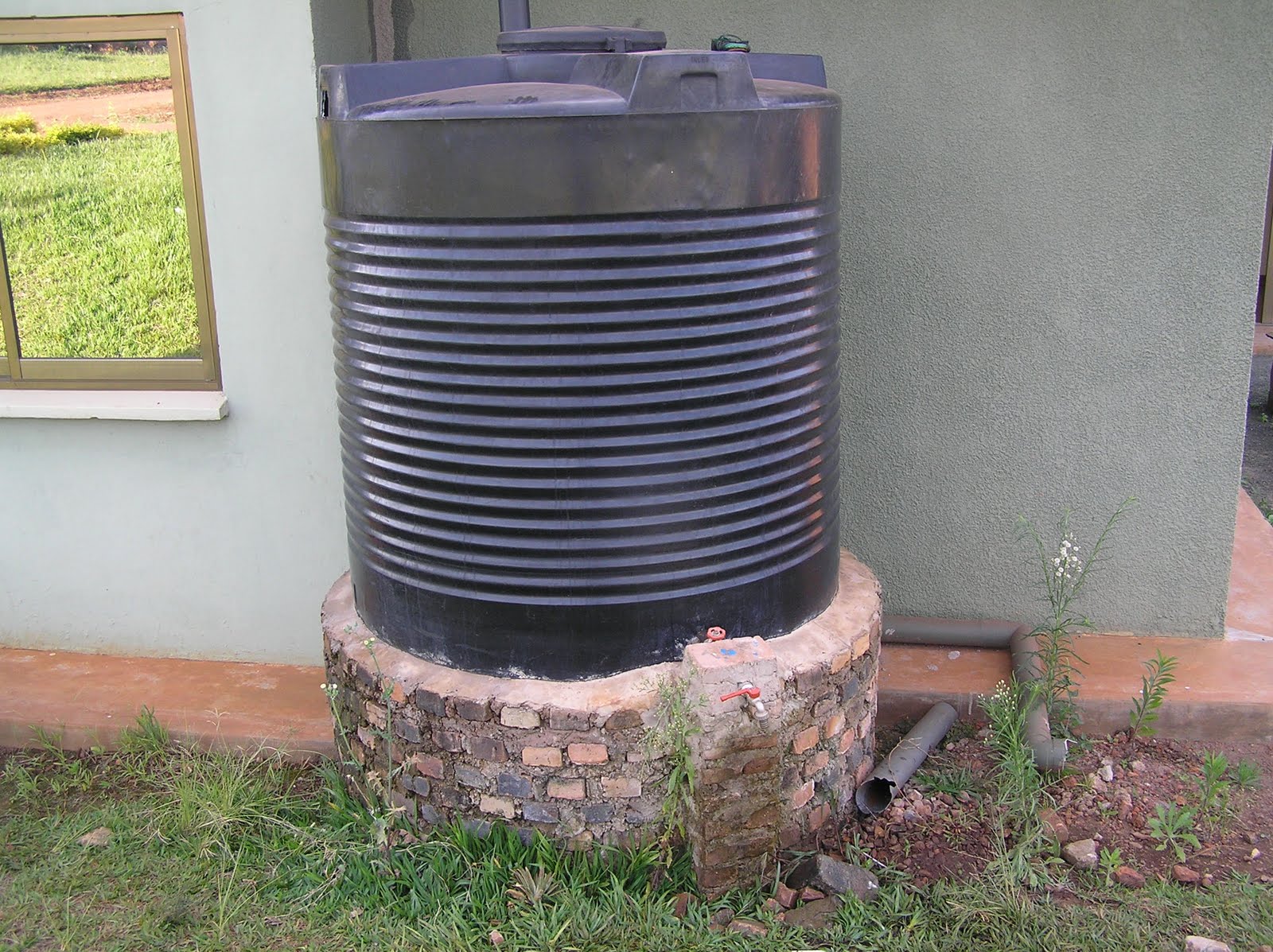
We have an excellent water situation, especially for a rural area. Agahozo Shalom Youth Village provides clean water, flush toilets, and sewage treatment for its 375 (soon to be 500) students through several wells that use electricity to pump water into two 30,000 liter towers for storage. The water towers connect to all buildings, and it is like we have a tap. We also have large rain barrels that store water from the roof on each house. 

This is one of two water storage tanks for Agahozo-Shalom. Providing
clean water and sanitation is a major service we provide for our
students.

There are some limitations to our water system. When the electricity goes out, which happens a few times a month, the water is soon to follow. If the village collectively uses the water too quickly, then nothing comes out of the tap. In this current dry season, when rain barrels do not fill up, overuse is a problem. The Environment Club conducted some water-conservation education earlier this year because village inhabitants used too much every day and pumps were breaking due to overworking. In June, we were bringing water from the second water tower for drinking and flushing, but we had to haul it up to 1km. You use only what you really need when you have to haul it. June was a smelly month for us without enough water for washing; I went without a shower for 12 full days and got lucky when the water came on briefly. Michele missed that opportunity and could not shower for 16 full days. Even with a good system in place, water is a resource that must be used wisely.


The rain barrel attached to our house stores water for washing, flushing,
and cleaning. We always boil this water if we are going to drink it.

We purify our drinking water just to be safe. There are several ways to purify water. We use a gravity-based filter system. One bag hangs high to hold unfiltered water, allows water to feed into the 0.02 micron filter at mid-level, and then flows into the low clean-water bag. We store up to 6 liters at a time in water bottles. While we know plenty of people who drink unfiltered water from the tap, we also know several people who suspect they got parasites from the water. Plus, the dirt residue left in the tube that leads to the filter tells me the water could be cleaner. 


Living here in rural Rwanda has shown me how vital access to clean water is. It seems like a no-brainer, but I never experienced shortages living in the States. I have a good water situation here, but even sometimes I have to haul water or go without. For all the hundreds of millions of people that do not have access to pumps and wells, their lives are at risk on a daily basis. Water is indeed the elixir of life.


How can you help people who do not have access to safe water?

Installing wells and pumps improves the lives of many who do not
have access to clean water.

-There are many other organizations working on access to improved water and sanitation facilities. I cannot endorse any specific organization because I have no personal experience with them. However, I read the websites of several for this article and found water.org to be a promising, respected NGO working on water access in Africa.

-Appreciate your water supply and conserve water. As populations increase, pressure on water supplies will grow. Will your fresh water supply be safe throughout your lifetime?

To learn about your water supply (in the United States), “you should ask your water utility (the one that sends water bills to people in your community) for a copy of its annual water quality report, which is sometimes called a right-to-know report or consumer confidence report. Then get the brochure called "Making Sense of Your Right to Know Report," (see www.safe-drinking-water.org/rtk.html) to help you understand the report. Read your report carefully and contact your health care provider if you have questions.”[8]

Works Cited

[2] UNICEF and World Health Organization Joint Monitoring Program, 2010 Update, “Progress on Sanitation and Drinking-Water.” http://www.wssinfo.org/data-estimates/introduction/
[5] Ministry of Finance and Economic Planning, Republic of Rwanda, 2010 Update, “Rwanda Vision 2020.” http://www.minecofin.gov.rw/ministry/key/vision2020
[6] UNICEF and World Health Organization Joint Monitoring Program, 2010 Update, “Progress on Sanitation and Drinking-Water.” http://www.wssinfo.org/data-estimates/introduction/
[7] Ministry of Finance and Economic Planning, Republic of Rwanda, 2010 Update, “Rwanda Vision 2020.” http://www.minecofin.gov.rw/ministry/key/vision2020
[8] Natural Resources Defense Council, 2006. http://www.nrdc.org/water/drinking/qtap.asp


Note on photographs: I only take photographs of people if I have their permission. Many people do not wish to have their picture taken, and I respect that. The only times I do not seek permission are in the case of illegal activities such as deforestation inside protected areas or poaching.

Thursday, September 1, 2011

Eating Bees!


Northern Carmine Bee-eater (Merops nubicus). Murchison Falls
National Park, Uganda

Bright blues, reds, yellows, oranges, pinks, and greens whiz by in the air. Half of the spectacle is the bright colors shared by both males and females. The other half of the spectacle is that bee-eaters catch bees in flight!


White-throated Bee-eater (Merops allbicolis). Mabamba Swamp environs,
Uganda

As their name suggests, bee-eaters hunt bees, but they also eat wasps and other flying insects. According to the Bird Families of the World website, bee-eaters catch bees and wasps by their wings and then pound and rub them to destroy and detach the venom sacs.


Red-throated Bee-eater (Merops bulocki). Murchison Falls National Park,
Uganda


These spectacular birds are not found in the Americas- sorry, Western Hemisphere, you are missing out. Different bee-eater species can be found in Africa, Asia, Australia, and Europe.


Blue-breasted Bee-eater (Merops variegatus). Mabamba Swamp, Uganda.
This bird is extremely similar to the next two. Note that this bird has yellow
cheek patches that fade to white and a dark blue breast band. It lives
in papyrus swamps.

My first exposure to bee-eaters was at the Bronx Zoo in the World of Birds exhibit. Michele and I attended a feeding time where the zookeeper tossed crickets into the air; the bee-eaters snagged them in the air! 


Cinnamon-chested Bee-eater (Merops oreobates). Agahozo-Shalom
Youth Village, Rwanda. This bird also has yellow cheek patches that
fade to white, but it lacks the navy in the breast band. It is also a
specialist of highland areas above 1500 meters.

In Israel in 2009, we listed bee-eaters as a top priority to see. You can see three bee-eaters in Israel, with the little green bee-eater breeding in the south and the European bee-eater breeding in the north, where we would focus most of our efforts. Unfortunately, in nearly three weeks we couldn't find a single bee-eater! We even resorted to standing next to bee hives at the suggestion of a park manager. No luck. Why? Some bee-eaters are migratory. We had gone at a time when many birds were pouring into Israel on their journey to Africa, but some of its birds were also flying away.


Little Bee-eater (Merops pusillus). Papyrus swamp fringing Lake
Mugesera, Rwanda. This bird is smaller than the previous two and its
yellow cheek patches do not fade to white.

When studying birds before coming to Rwanda, there were clearly a lot of bee-eater possibilities.  I am thrilled to have photographed all ten species that we have seen. Enjoy them!


White-fronted Bee-eater (Merops bullockoides). Arusha National
Park, Tanzania


Blue-cheeked Bee-eater (Merops persicus). Akagera National Park, Rwanda


Swallow-tailed Bee-eater (Merops hirundineus). Note its notched tail.
Murchison Falls National Park, Uganda


European Bee-eater (Merops apiaster). Akagera National Park, Rwanda


Sources
  • Fanshawe and Stevenson. Birds of East Africa. Princeton and Oxford: Princeton University Press, 2002. 

  • Roberson, D. "Bee-eaters: Meropidae." Bird families of the World. Accessed 1 September 2011. http://creagrus.home.montereybay.com/bee-eaters.html